Summer Months Usher in Deadliest Period for Teen Drivers
Greater Washington Nonprofit Urgers Parental Involvement to Prevent Underage Drinking
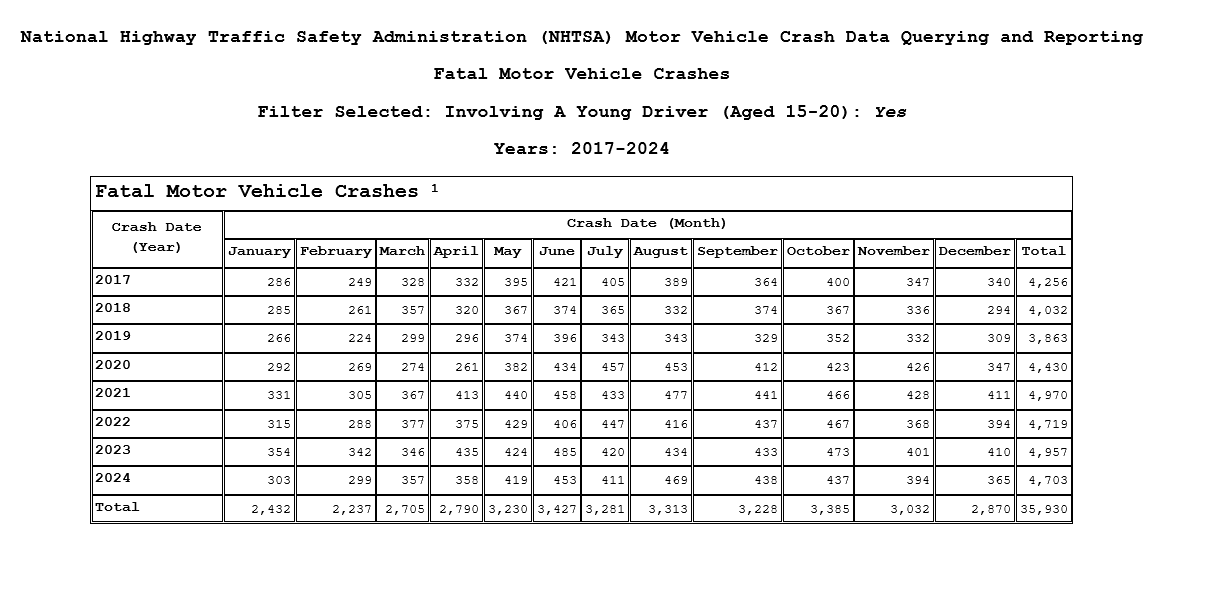
Tysons, VA, May 19 — Citing the fact that the summer months usher in the contiguous period (June-September) when the greatest number of U.S. teen traffic deaths occur [i], a Washington-area alcohol education group is urging parental involvement to combat both underage drinking and drunk driving this summer.
![[i]](/wp-content/uploads/2026/05/26-chart.png)
The Tysons-based nonprofit Washington Regional Alcohol Program (WRAP) is providing area parents of teens with Ten tips for Parents to Prevent Underage Drinking (which are available as a downloadable and or printable pdf). WRAP’s ten annual summer tips, designed to inform Greater Washington parents on how best to deter underage drinking during the dangerous summer months, include:
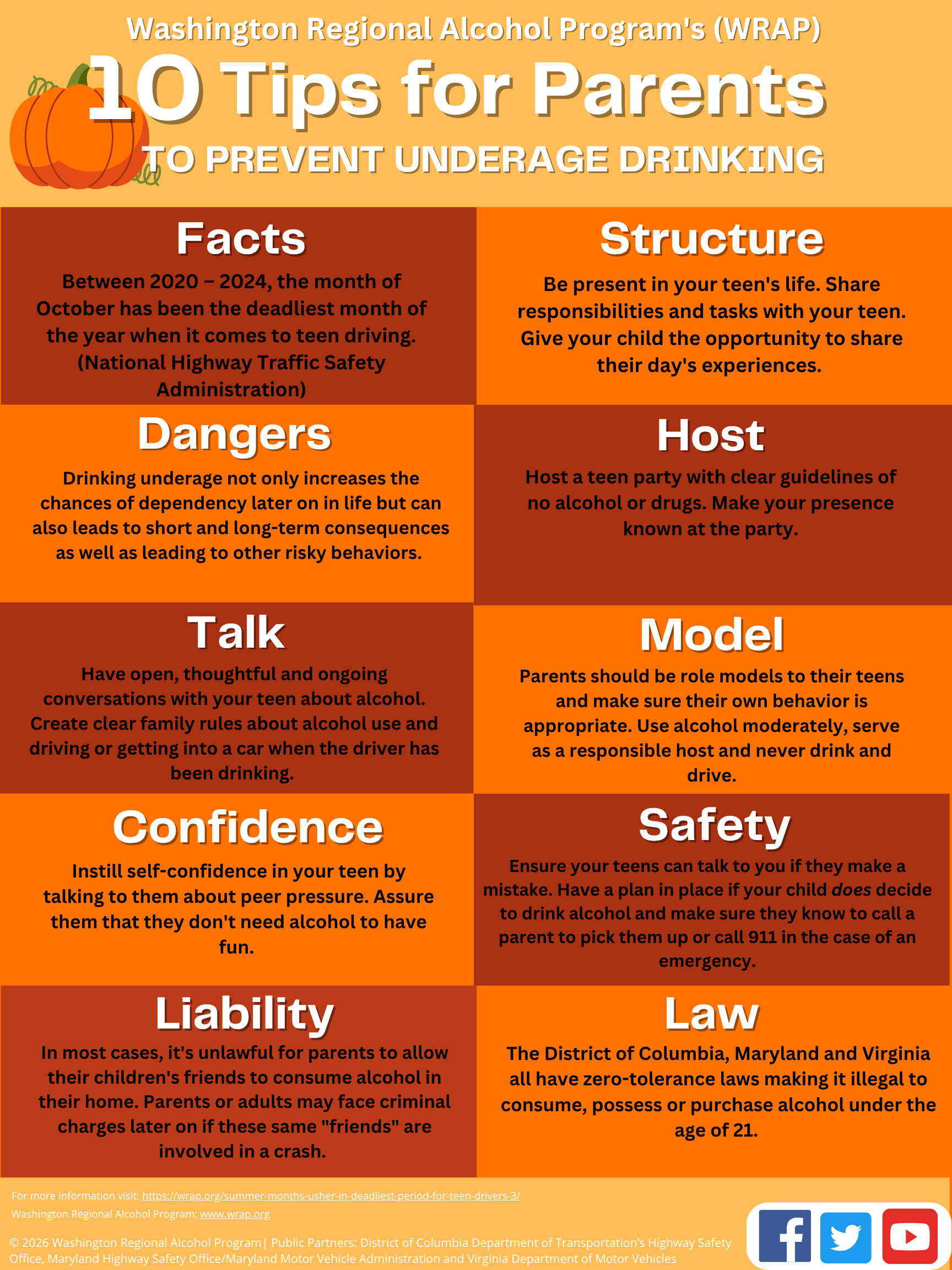
- Understand the Dangers… Drinking underage not only increased the chances of dependency later on in life but also leads to short and long-term consequences as well as leading to other risky behaviors.
- Know the Law… The District of Columbia, Maryland and Virginia all have zero-tolerance laws making it illegal to consume, possess or purchase alcohol underage the ages of 21.
- Be a Role Model… Parents should be role models to their teens and make sure their own behaviors are appropriate. Use alcohol moderately, serve as responsible hosts and never drink and drive.
- Know your Liability… In most cases, it is unlawful for parents to allow their children’s friends to consume alcohol in their home. Parents or adult may face criminal charges later on if these same “friends” are involved in a crash.
“In 2024, more than dozen teenagers died in U.S. motor vehicle crashes every single day during the summer months (14.4/day, June-September), “said WRAP President Kurt Erickson.” For too many parents, unfortunately, summer’s unstructured time may also be a deadly time for their teenage children and their friends.”
In 2023, 30-percent of young drivers (ages 15-20 year old) killed in U.S. crashes had been drinking (with a blood alcohol concentration [BAC] level of 0.01 grams/deciliter or higher) according to the National Traffic Safety Administration (NHTSA). That same year, a quarter (26%) of young drivers killed in U.S. traffic crashes had a BAC of 0.08 g/dL or higher. [ii]
NHTSA data further shows that while young drivers comprise just five-percent of all licensed drivers in the U.S., they account for 8.9-percent of all drivers involved in fatal crashes. [ii]
While the 2026 Monitoring the Future survey sponsored by the National Institute on Drug Abuse shows that alcohol use among U.S. 10th and 8th graders continued to decline, alcohol use among 12th graders slightly increased compared with 2024 data. [iii]
“Make no mistake about it, parents play an integral role in when and if their children drink alcohol,” said Erickson. “These tips are simply meant to reinforce their efforts to foster a healthy and safe summer for them and their teenage children.”
Founded in 1982, the nonprofit [501(c)(3)] Washington Regional Alcohol Program (WRAP) is an award-winning public-private partnership working to prevent drunk driving and underage drinking in the Washington-metropolitan area. Through public education, innovative health education programs and advocacy, WRAP is credited with helping to keep the annual percentage of metro-Washington traffic deaths involving alcohol-impaired driving historically lower than the national average. WRAP, however, may best be known to area residents via the organization’s popular free safe ride service to prevent drunk driving, SoberRide.
For more information, visit WRAP’s website at www.wrap.org.
[i] National Highway Traffic Safety Administration (NHTSA) / Fatality Injury Reporting System Tool (2017-2024, below)
[ii] NHTSA Traffic Safety Facts: Young Drivers (July 2025, 2023 Data) https://crashstats.nhtsa.dot.gov/Api/Public/ViewPublication/813736
[iii] 2026 Monitoring the Future survey https://monitoringthefuture.org/wp-content/uploads/2025/12/mtfvol12026.pdf